
Community & Consumer
When You Book Through a Broker, Your Neighborhood Loses
Moving broker platforms promise convenience — but the hidden cost is borne by your community, your consumer rights, and the small local businesses that actually know how to move your home.
The LocalMovings.com Team
Licensed & Insured Houston Movers · 15+ Years Serving Our Community
Every time a family in our city books a move through an out-of-state broker platform, a small local moving company loses a job. The platform pockets a fee. A gig worker with no formal training shows up at someone’s door. And the community — the web of locally owned businesses, working families, and neighborhood reputations that hold a city together — gets a little bit weaker. This is not abstract. It is the daily reality of what broker-based moving platforms have done to local moving markets across America, and it is happening right here.
We’ve been moving Houston families for over fifteen years. We’ve watched the rise of these platforms with a mixture of concern and frustration — not because we fear competition, but because we’ve seen what happens when families trust the wrong model. Furniture broken. Claims denied. Strangers who showed up without a truck, without training, and without accountability. And a platform customer service line that was, for all practical purposes, useless.
This piece is for the people who want to make an informed choice — and for anyone who believes that keeping money in your community matters.
What a Moving Broker Actually Does
A moving broker does not own trucks. They do not employ movers. They do not show up at your home. What they do is collect your booking — and a significant cut of your payment — then route your job to whatever carrier or gig worker accepts it, sometimes at the last minute, often at the lowest rate.
The pitch is convenience: one platform, hundreds of providers, easy online booking. What it actually delivers is distance — between you and the person handling your belongings, between your payment and the worker who earns it, and between a problem on moving day and anyone with the authority to fix it.
“When something goes wrong with a broker booking, you discover there are two parties blaming each other — and neither one is standing in your living room.”
— LocalMovings.com, Houston Moving Professionals
How Broker Platforms Hurt Small Local Moving Companies
Small local moving companies are not faceless corporations. They are owner-operated businesses — often started by someone who drove a truck themselves for years before saving enough to buy their own. They employ local people. They pay local taxes. They sponsor little league teams and show up to neighborhood events. They have everything to lose if they do a bad job, because their reputation lives or dies in the community they serve.
Broker platforms systematically undercut these businesses in ways that have nothing to do with quality of service.
They Compete on Visibility, Not Value
Broker platforms spend heavily on search engine advertising and SEO. When a Houston family searches “movers near me,” they are increasingly likely to see a broker platform — not a local company — at the top of the results. The platform wins the click not because it provides better service, but because it has a larger marketing budget than any small local mover can match. The local company, despite 15 years of excellent service and hundreds of five-star reviews, gets buried on page two.
They Extract Value From the Community Without Returning It
When you pay a broker platform, a substantial portion of that payment leaves your community immediately — routed to a corporate headquarters in another state or to investor returns. The local worker who does the job sees a fraction of what you paid. The local moving company that could have done the job sees nothing. Compare that to booking directly with a local mover: every dollar stays in the local economy, cycles through local suppliers, payroll, and taxes, and reinforces the economic fabric of the neighborhood.
They Set a Price Floor That Devalues Professional Moving
By flooding the market with low-cost, low-training gig labor, broker platforms create artificial price pressure that forces legitimate moving companies to either race to the bottom on pricing — compromising on training, equipment, and insurance — or lose market share to providers who cut those corners without consequence. The consumer who books the cheapest broker job gets what they pay for. The local moving industry, as a whole, suffers for it.
- Every direct booking with a local mover keeps wages, taxes, and profits circulating in your city
- Local moving companies are licensed and regulated by state authorities — they have legal accountability that gig platforms do not
- A local mover’s reputation is built over years in your specific community — they cannot hide behind a platform if something goes wrong
- Small moving companies employ full-time local workers with consistent training, not on-demand gig labor
- Direct relationships with local movers mean transparent pricing — no platform fees, no hidden markups
- Supporting local movers preserves competition and quality in your market for years to come
What You Give Up as a Consumer
Beyond the community economics, the broker model creates specific, concrete risks for the person booking the move. These are not edge cases — they are structural features of how the broker model works.
You Don’t Know Who Is Coming
With a direct booking, you know the company. You can call them, read their Google reviews in your city, verify their license, and speak to a manager. With a broker, the specific provider is often not confirmed until close to moving day — and may change without notice. The person who shows up may be excellent. They may be someone who signed up on the platform yesterday. You have no reliable way to know in advance.
Your Insurance Is the Federal Bare Minimum
Under federal law, the default liability for moving damage is 60 cents per pound of damaged item. This is the floor — and for broker-arranged moves, particularly labor-only gig jobs, it is often the ceiling as well. A television set weighing 25 pounds, damaged beyond repair, generates a claim of $15. A solid wood dining table at 80 pounds: $48. Consumers who discover this after the fact are, understandably, furious — and have very little recourse.
Accountability Disappears When You Need It Most
Moving day problems — a no-show, damaged furniture, a job that runs far over the quoted time — require someone with authority to fix them, immediately. Broker platforms offer customer service channels designed to manage complaints, not solve problems. The local worker assigned to your job has no power to authorize refunds or expedite replacements. The platform has no liability for the worker’s actions. You are caught between two parties, neither of whom considers the problem fully their responsibility.
- Broker platforms typically disclaim liability for actions of their contracted carriers or helpers in their terms of service
- Default damage coverage on broker-arranged moves is often 60¢ per pound — the federal minimum
- Local labor-only arrangements often fall outside FMCSA oversight, meaning no federal consumer protections apply
- Provider assignments can change without notice — the person you reviewed may not be the person who shows up
- Platform fees and carrier rates are separate — total cost is frequently higher than the advertised rate
- Claims processes through broker platforms can take weeks and offer limited resolution options
Broker vs. Local Mover: A Clear Comparison
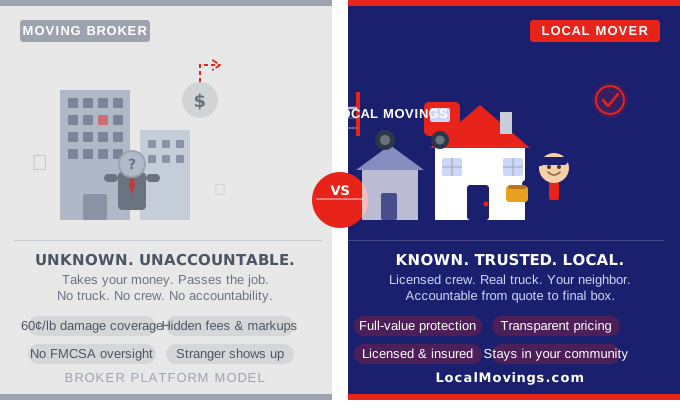
| What You’re Comparing | Broker Platform | Local Licensed Mover |
|---|---|---|
| Where your money goes | Significant cut leaves your community | Stays local — wages, taxes, reinvestment |
| Who shows up | Unknown until day-of; may change | Same crew, confirmed in advance |
| Training & professionalism | Self-reported; no enforced standard | Trained, supervised, experienced crew |
| Damage liability | Often 60¢/lb federal minimum | Full-value coverage available |
| Accountability | Platform vs. carrier blame cycle | One company, fully responsible |
| Community impact | Extracts value from local economy | Reinvests in your neighborhood |
| If something goes wrong | Help desk ticket; limited resolution | Direct management; problem solved |
How to Hire a Mover the Right Way
Protecting yourself — and your community — doesn’t require extra effort. It just requires asking the right questions before you book.
Your Pre-Booking Checklist
- Ask for a USDOT number. Verify it on the FMCSA website. No number is a red flag for interstate moves.
- Confirm state licensing. In Texas, moving companies must be registered with the TxDMV. Ask for the registration number.
- Request a written, itemized estimate. A professional mover will scope your move and provide a written quote — not a ballpark based on a form.
- Ask about full-value protection. Understand what coverage is included and what additional options exist. Don’t assume the default is adequate.
- Check local reviews specifically. Look for Google or BBB reviews from your city. A company with 200 local reviews is accountable in a way a platform aggregate is not.
- Confirm who is doing the work. Ask directly: are you a moving company, or are you a broker who will assign my job to another provider?
The Bigger Picture
The rise of broker platforms in the moving industry is part of a broader economic pattern: outside capital entering local service markets, replacing stable local employment with gig labor, extracting value from communities while offering convenience as the trade-off. It has happened in transportation, in food delivery, in home services. Moving is simply the latest frontier.
We are not opposed to technology or to competition. What we are opposed to is a system that deceives consumers about what they’re buying, strips protections they don’t know they’re losing, and quietly drains local economies while spending heavily to appear indistinguishable from the local businesses they’re displacing.
The next time you need to move, you have a choice. You can click “Book Now” on a platform designed to capture your payment as quickly as possible. Or you can spend five minutes calling a local company — one whose name is on a truck in your neighborhood, whose owner answers the phone, and whose reputation is built on the same streets your furniture is traveling.
That choice, made by enough people in enough cities, is the difference between a thriving local moving industry and a gig economy where the only winner is the platform.
We are not a broker. We are not a platform. We are a licensed, insured, locally owned Houston moving company. Every crew member is trained and employed by us. Every move we complete is our reputation on the line. When you book with us, your money stays in Houston — and so does our commitment to getting your move right.
Book Direct. Keep It Local.
Get a transparent, all-in quote from a real Houston moving company — no broker, no surprises, no fine print.
Moving Tips
Consumer Rights
Houston Movers
Small Business
Moving Industry
